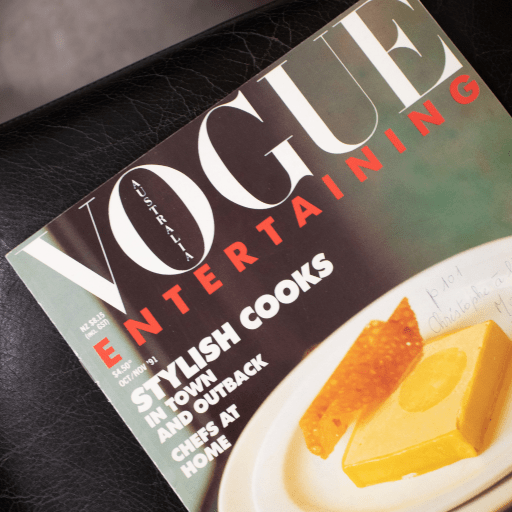
WHEN MONTALAMBERT WAS ALREADY VOGUE’S BEST HOTEL IN PARIS
Categories : Our Hotel, published on : 10/6/26
You have to look at the images as if opening an archive. In the pages of Vogue, in the early 1990s, Hôtel Montalembert already stood apart. Not a palace in the ostentatious sense of the word. Rather, a discreet, cultivated, almost confidential Parisian home, where every detail seems to have been chosen to last. Vogue summed up the spirit of the place in just a few words: “Left Bank Parisian chic”, an understated Rive Gauche elegance shaped by refinement and calm. A cream-coloured rug in the entrance, blond wood panelling, a fireplace, graphic stripes on the bed, a restaurant table conceived as a neighbourhood rendezvous. At the time, Vogue also spoke of an “unpretentious” luxury, in other words, luxury without ostentation. Even today, the expression says a great deal about the spirit of the hotel.
Built in 1926, the hotel retains a sense of depth that newly built addresses cannot imitate. Behind its original façade, the Left Bank naturally finds its way in. Rue Montalembert, the proximity of Saint-Germain-des-Prés, the Musée d’Orsay, galleries, bookshops and the Seine quays create a very real setting. Vogue already noted that the hotel had been “a retreat for writers and artists.” Montalembert has never simply been a hotel located in Paris. It has always been a fragment of the city itself.
INTERIORS
by Christian Liaigre
RESOLUTELY MODERN FOR ITS TIME
What stands out in the Vogue article is the modernity of its perspective on the interior design. Christian Liaigre, then described as a rising star of international design, imagined understated, elegant and warm interiors at a time when hotel luxury was still often associated with gilding, drapery and displays of grandeur.
Here, the approach was different. Liaigre worked with lines, materials and the sense of space within each volume. From the entrance, the staircase sets the tone: a graphic, almost sculptural presence that connects the building’s history with a more contemporary interpretation of the property. Vogue praised these clean lines and bright, balanced spaces, where wood immediately creates a feeling of warmth. Sycamore panelling, oak floors, bronze lighting by Eric Schmitt, delicately embroidered Pierre Frey linens and silky textures do not seek spectacle. They create an atmosphere. Even the deep armchairs, designed for guests to truly settle into, contribute to this idea of intimate, comfortable luxury. The use of light also seems essential: discreet lamps, soft glows, reflections on the wood and subdued lighting create a setting that feels more sensitive than demonstrative.
Vogue speaks of interiors “with humour and style”, a phrase that perfectly captures the balance at play: seriousness in the materials, freedom in the details. The article also highlights “simple lines interwoven with distinctive furniture”. Perhaps this is where Montalembert was ahead of its time: conceiving luxury as a discreet experience, attentive to comfort as much as aesthetics.
What was distinctive then has become almost self-evident today. Hotels now speak of design, intimacy, residential warmth and spaces designed to be lived in. Montalembert, however, was already exploring this idea. It offered a hotel where guests could feel at home, with the precision of hotel service added.

WHAT WE KEPT
and what we left behind
Rereading Vogue also means seeing what time preserves and what it corrects. Certain elements remain timeless: the 1926 façade, the library-bar spirit, the pleasure of an open fire, natural materials, and the dialogue between art, literature and design. The article also mentions “a splendid library and bar”, where guests could relax “in front of an open fire.” Other elements, however, belong more clearly to another era.
The Louis-Philippe beds, for example, perfectly illustrate this passage of time. Their silhouette had charm, presence and a very Parisian historical reference. Vogue described some of the rooms as being in a “Louis Philippe style”, alongside more contemporary spaces featuring sycamore furniture with a distinctly Left Bank character. In practical terms, however, these beds responded more to a decorative idea of comfort than to the expectations of a contemporary five-star stay. Today, a bedroom can no longer simply be beautiful. It must support the body, promote sleep and provide immediate comfort. Traditional bed structures have given way to contemporary bedding designed to combine firm support with softness, mattress technology with an enveloping sensation.
The same comparison applies to the bathrooms. Vogue mentioned bathrooms with “Italian marble floors”, “deep tubs” and “tall, pivoting mirrors.” Some details remain desirable, while others have evolved alongside changing habits. Today, luxury hospitality seeks greater fluidity, more light and more practical comfort, without sacrificing the beauty of the materials. Marble, wood, textiles, soft shades and refined finishes now create a more contemporary and better-adapted sense of comfort.
THE STRIPED SHEETS
a detail that was already remarkably modern
Among the most striking details in the Vogue photographs, the black-and-white striped sheets immediately catch the eye. They give the room a strong visual signature, almost couture-like. In the 1990s, this choice stood apart from the more conventional codes of traditional hospitality. The stripes brought rhythm, graphic character and a certain Left Bank boldness.
This is where Montalembert proved visionary. In the article, Vogue already contrasts several room atmospheres, moving between historical references and more contemporary décor, while highlighting an “undeniable Left Bank character.” Bed linen became part of the identity, not simply an accessory. Guests were not sleeping in a standardised room, but in a room with a point of view.
The stripes may no longer appear in quite the same way, but the idea remains: creating a recognisable interior without weighing it down. Today, this individuality is expressed through softer materials, calmer palettes, enveloping seating, subdued lighting and elegant textiles. The style has changed, but the intention remains the same.

THE TABLE
from literary café to neighbourhood address
Another revealing element in the Vogue archive is the importance given to the table. The article does not simply describe a hotel; it tells the story of a place where people eat, linger and visit even when they are not staying overnight. Vogue refers to the “early literary cafes” of the Left Bank, and it is precisely this atmosphere that Montalembert already seemed intent on continuing.
An apple tart caramelised with honey, fresh pasta, a tomato and mozzarella salad with basil, the fish of the day prepared to order: the cuisine photographed speaks of simple, accessible elegance, without unnecessary staging. The article describes the pleasures of a “simple and modern cuisine”, served throughout the day, from morning café au lait to more spontaneous lunches and dinners.
Here again, Montalembert was ahead of its time. At a moment when a hotel restaurant could still be regarded as a secondary service, the property was already embracing the idea of neighbourhood life. Breakfast, lunch, dinner, a drink at the bar, tea by the fireplace: together, they created a continuous destination, open to the rhythm of Parisian life throughout the day.
Today, this approach has become essential. A five-star hotel can no longer be limited to its bedrooms. It must offer a restaurant people genuinely want to visit, an atmosphere in which to meet, work, read, dine and return. Montalembert retains this vocation: that of an elegant refuge in the heart of Saint-Germain-des-Prés.
A MODERNITY
that does not deny its history
What is most interesting, ultimately, is seeing how Montalembert has transformed its heritage without betraying it. The most enduring elements of its original identity remain: discretion, location, the fireplace, the library, the materials, and the connection with art and literature. Less suitable elements have disappeared: overly restrictive furniture, decorative forms that lacked practicality, and certain habits belonging to another era.
In their place, the hotel has gained comfort, softness and fluidity. The materials are more contemporary, yet always warm. The rooms are designed to be beautiful, but also restful. Comfort is no longer simply an aesthetic promise; it becomes a physical experience: sleeping better, moving more easily, feeling better.
Perhaps that is the true luxury of a century-old hotel: not freezing its past in time, but using it as a living material. In the 1990s, Vogue already saw Montalembert as “a small, exciting haven” for those who wanted to discover the real Paris. More than thirty years later, the description still rings true: the hotel has changed, but it has retained what already made it special — a quiet elegance, a culture of detail and a distinctly Parisian way of never trying too hard.
